


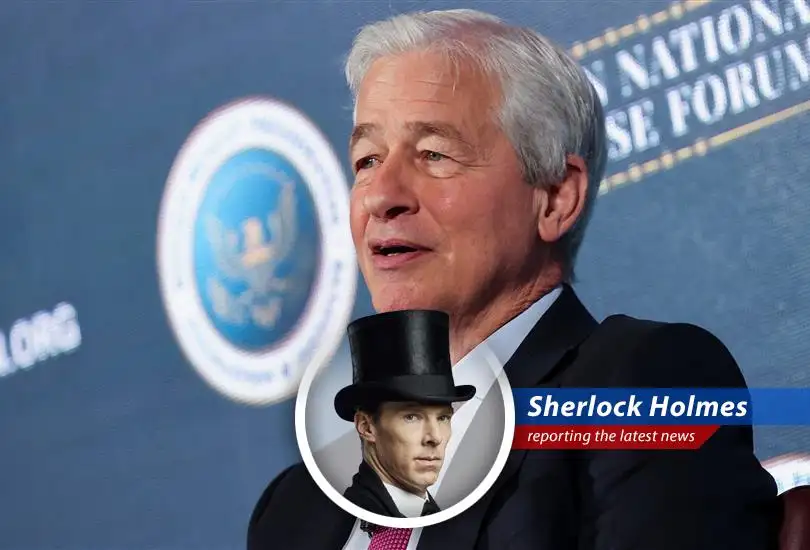
- Jamie Dimon emphasizes a recommitment to American values amidst global uncertainty.
- Geopolitical tensions and trade policies pose primary risks to JPMorgan Chase.
- Dimon critiques financial regulations, citing fragmentation and excessive rules.
- Artificial intelligence is deemed transformational, yet its ultimate impact remains uncertain.
A Call to Arms (and Ideals)
As the self-proclaimed consulting detective, I find myself perusing matters of finance with a keen, albeit unconventional, eye. Jamie Dimon's annual letter is, to the financial world, what a baffling murder is to Scotland Yard a curious case demanding immediate attention. Mr. Dimon, in his verbose yet insightful manner, calls for a recommitment to American ideals, a notion as quaint as it is necessary in these turbulent times. One might say it's elementary, my dear shareholders, but the obvious is often overlooked.
The Geopolitical Game: A High-Stakes Gambit
Dimon identifies geopolitical tensions as the primary threat, wars in Ukraine and Iran casting long shadows over commodities and global markets. War, he correctly notes, is the realm of uncertainty. Such pronouncements are hardly earth-shattering, but they serve as a grim reminder that the world stage is less a carefully constructed play and more a chaotic improv show. I observe such dynamics and can't help but wonder if some players are merely pawns in a larger, more sinister game, much like the unfortunate victims I often encounter in my line of work. These market participants should take note of the situation with Novo Nordisk Stumbles Weight-Loss Race Eli Lilly Charges Ahead, to better navigate this changing landscape.
Regulation Rigmarole: A Bureaucratic Labyrinth
Ah, regulations a subject as thrilling as a tax audit, yet as essential as a solid alibi. Dimon critiques the financial regulations, noting their fragmented, slow-moving nature. He suggests that post-2008 reforms, while well-intentioned, have created a system rife with excessive rules that, ironically, weaken the financial structure. It seems the cure, in this case, might be as detrimental as the disease, a conundrum not unlike attempting to solve a crime with too many conflicting clues.
Private Markets Under the Microscope
Dimon addresses the turmoil in private markets, where transparency is as elusive as a phantom and valuations are as reliable as a politician's promise. He warns of potential insurance regulator interventions that could trigger demands for more capital. One might say that this situation calls for a magnifying glass and a meticulous examination of the fine print, lest one be caught in a financial quicksand of their own making.
The AI Enigma: Friend or Foe?
Artificial intelligence, the modern-day Frankenstein's monster, looms large in Dimon's letter. He acknowledges its transformative potential while cautioning against speculative exuberance. AI, he says, will bring significant benefits, but the ultimate victors and vanquished remain unknown. As I've often said, "It is a capital mistake to theorize before one has data." In this case, the data is still being gathered, and the implications are as unpredictable as the whims of a seasoned criminal.
Final Thoughts: Elementary, My Dear Shareholders
In conclusion, Mr. Dimon's letter paints a complex portrait of a world grappling with economic, geopolitical, and technological uncertainties. His call for a recommitment to American ideals is a welcome sentiment, even if it feels somewhat like prescribing tea and sympathy for a gunshot wound. As for the rest, only time will tell whether his predictions come to fruition. But as I always say, "Data, data, data I can't make bricks without clay."
Jamie Dimon JPMorgan Chase shareholder letter geopolitics financial regulations artificial intelligence trade policy global economy banking American ideals
Comments
From Sherlock Holmes




Breaking News






All Rights Reserved © 2023
shane09
The points on trade policy are well-taken.