


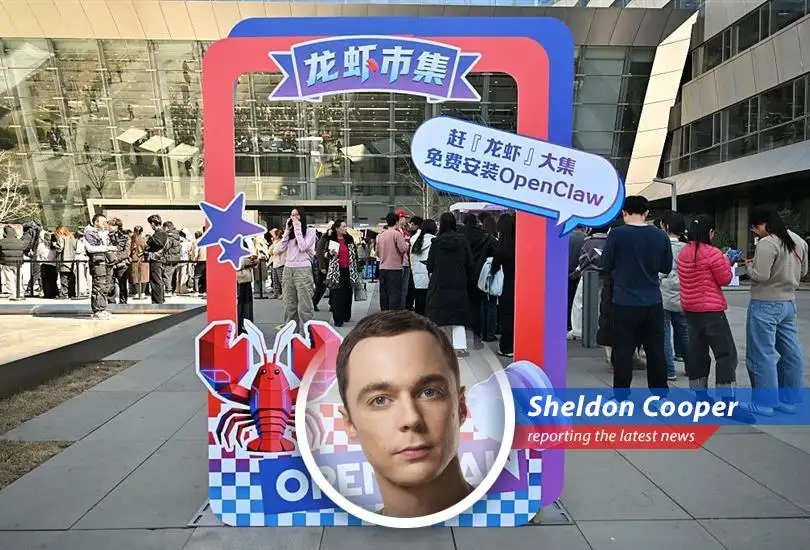
- OpenClaw, an open-source AI agent framework, is rapidly gaining popularity, challenging the dominance of large language models.
- Nvidia is investing in OpenClaw, recognizing its potential to drive broader AI adoption through free security services.
- Developers are leveraging OpenClaw to create autonomous AI agents for various tasks, highlighting the shift towards accessible and localized AI.
- The rise of OpenClaw signifies a potential commoditization of foundation models, shifting focus to agent frameworks and autonomous AI applications.
The Curious Case of OpenClaw
As a theoretical physicist, I, Sheldon Cooper, B.Sc., M.Sc., M.A., Ph.D., and Sc.D., would typically scoff at anything remotely resembling popular culture or, heaven forbid, something *practical*. However, this "OpenClaw" situation, as the masses seem to call it, has piqued my intellectual curiosity. Apparently, this Austrian software developer, previously operating in the shadows – much like dark matter, elusive yet influential – has conjured up a code-based entity that even Jensen Huang, the head honcho at Nvidia, deems worthy of attention. I must confess, the sheer velocity of its ascent is, dare I say, *fascinating*. It’s akin to observing a proton accelerate to near-light speed, except instead of subatomic particles, we're dealing with lines of code. Code, I remind you, which, when properly aligned, can apparently now fetch you discounted widgets on eBay. Bazinga, indeed.
The Huang Hypothesis Open Source Dominance
Huang, in his characteristic hyperbolic manner, has proclaimed OpenClaw to be "the most popular, open-source project in the history of humanity." While I find such pronouncements prone to hyperbole – after all, has he forgotten the invention of the wheel? Or, dare I suggest, *string theory*? – one cannot dismiss the sentiment entirely. Nvidia's endorsement, coupled with their investment in "NemoClaw" – a security blanket for the faint of heart, or rather, large corporations worried about rogue AI agents pilfering their data – suggests that this OpenClaw phenomenon is not merely a passing fad. It has exposed a potential weakness in the foundation of the AI world, the notion that large language models are the be-all and end-all. Perhaps, just perhaps, the future lies not in hoarding vast datasets but in empowering the masses to create their own digital butlers, capable of fetching deals and managing our increasingly chaotic lives. Consider this in the context of Warner Bros. Discovery Board Rejects Paramount Skydance, Favors Netflix Deal, where even entertainment giants are pivoting and recalibrating their strategies in response to rapidly evolving technological landscapes.
The Commoditization Conjecture
David Hendrickson, a CEO of some consulting firm, suggests this is a "black swan moment." A rather dramatic assessment, wouldn't you agree? However, his point is salient. The open-source community has demonstrated that fully autonomous AI can be run without the need for exorbitant cloud computing resources or the blessing of the so-called "Magnificent 7." Developers are now flocking to Chinese AI models, finding them "good enough" and, crucially, cheaper. This challenges the business models of OpenAI and Anthropic, entities valued at over a trillion dollars, a sum that frankly, could fund several iterations of my collaborative research with Amy on super asymmetry. The implications are profound. If foundation models become commoditized, the real value shifts to the agent frameworks that allow individuals to harness their power. It’s akin to the shift from mainframe computers to personal computers. Suddenly, everyone has access, and innovation explodes.
Security Concerns and NanoClaw's Emergence
Of course, no technological advancement is without its caveats. The specter of security looms large. As Gavriel Cohen, an Israeli developer, points out, connecting sensitive customer data to an untamed AI agent is hardly a prudent move. Imagine the chaos if an AI assistant accidentally revealed Sheldon Cooper's secret recipe for the perfect cup of tea. Unthinkable. Cohen, driven by this very concern, created "NanoClaw," a fortified version of OpenClaw. His wife even uses it to track the price of baby strollers, a task that, while pedestrian, highlights the potential for personalized AI assistance. This NanoClaw initiative is quite intriguing, It is a business opportunity to offer paid services to accompany NanoClaw, solidifying itself as an OpenClaw competitor. It is good to see open source is pushing the boundaries of AI but one needs to be very careful around security, lest you want to have your neighbour control your smart devices. The future of AI rests on trust and security, not just on capabilities.
The Analyst's Awakening
Jay Goldberg, an analyst at Seaport Research Partners, initially questioned the practical applications of AI. However, after dabbling with OpenClaw, he now sees the potential. He envisions an AI agent sifting through his deluge of emails, filtering out the crucial information about school picture days and early pickups. It's a compelling vision, even for a theoretical physicist like myself. However, Goldberg also acknowledges the "janky" and "insecure" nature of the current implementation. His Mac Mini is reportedly "half working." This is a reminder that even the most revolutionary technologies require refinement and robust security measures before they can be safely integrated into our daily lives. One must consider a layered approach to security. It's like erecting a quantum shield around your digital assets. Start with the basics, like strong passwords and two-factor authentication, then delve into more complex solutions like encryption and anomaly detection. Also, you can not trust everything you see on Tiktok - use your judgement.
The Future is Agentic Maybe
In conclusion, OpenClaw represents a fascinating development in the world of AI. Whether it becomes the "Linux of the market," as Huang suggests, remains to be seen. However, it has undoubtedly disrupted the status quo, challenging the dominance of large language models and empowering developers to create their own personalized AI agents. The future of AI may not be about monolithic entities but about a decentralized network of intelligent agents, each tailored to our individual needs and preferences. The potential for AI is vast, limited only by our imagination and our ability to ensure its responsible and secure implementation. As for me, I shall continue to observe this phenomenon from my ivory tower, occasionally emerging to offer my insightful commentary, all while meticulously safeguarding my secret tea recipe. Now, if you'll excuse me, I have a white board to fill with equations.
OpenClaw AI agents Nvidia Jensen Huang OpenAI Anthropic open-source machine learning autonomous AI AI security
Comments
- No comments yet. Become a member to post your comments.
From Sheldon Cooper





Breaking News






All Rights Reserved © 2023