


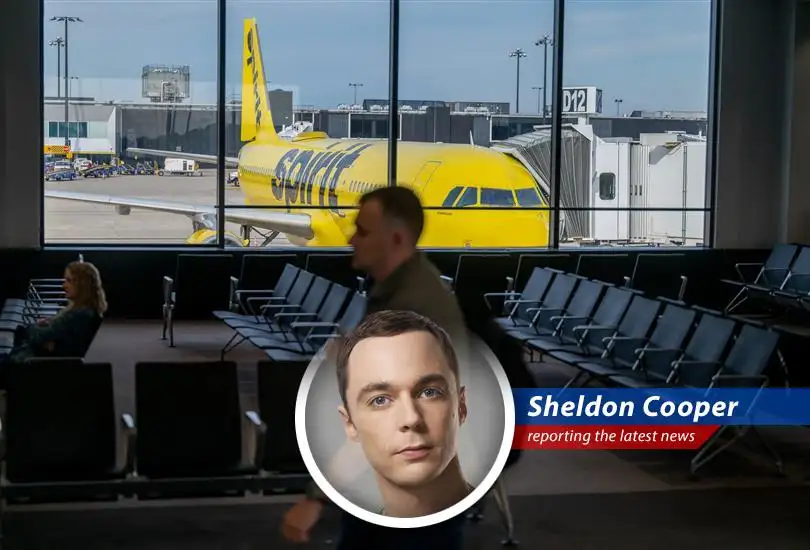
- Spirit Airlines is undergoing a structured dismantling following its bankruptcy filing.
- Rising jet fuel costs, exacerbated by geopolitical tensions, significantly contributed to Spirit's financial downfall.
- The airline's closure resulted in job losses for approximately 17,000 employees and travel disruptions for thousands of passengers.
- Bankruptcy court proceedings are underway to address asset liquidation, employee compensation, and creditor claims.
The Inevitable Dissolution A Confluence of Unfortunate Events
As Sheldon Cooper, theoretical physicist and staunch advocate for orderly systems, I find the demise of Spirit Airlines a fascinating, albeit unfortunate, case study in the chaotic nature of economics. The airline, after its rather lengthy, approximately three-decade run, has begun its dismantling phase. This whole situation reminds me of entropy; a system, in this case, an airline, moving from order to disorder. It's quite elementary, really. The airline is in bankruptcy court in White Plains, New York, initiating a process that promises to extend for several months. Clearly, their operational model was not optimized for minimum energy expenditure, a principle I hold dear, not unlike my adherence to a precise bathroom schedule.
Budgeting for Oblivion A $217 Million Wind-Down
The numbers involved are, shall we say, significant. A cumulative wind-down budget of around $217 million, projected through February 2028, is under consideration. This includes over $52 million allocated for employee costs through July and an additional $52 million earmarked for aircraft-related expenses. The airline had a substantial fleet, with 59 Airbus A320s in service and 63 in storage, along with 37 larger A321s in service and 13 in storage, according to Cirium. It seems that a substantial portion, more than three-quarters, of their fleet was leased. This entire fiscal scenario brings to mind the importance of understanding ones financial risk exposure; much like understanding the half-life of radioactive isotopes in nuclear physics. A critical detail, which one could argue represents a black swan event, the increase in jet fuel prices following geopolitical tensions, such as the U.S.-Israel attacks on Iran. This seemingly inconsequential, to some, event added a staggering $100 million in incremental costs for Spirit in March and April alone. It seems, the consequences of those events are rippling through the entire system, much like the ripples in a pond when you drop a pebble; or perhaps a very large rock. Speaking of economic disruptions, those interested in a deeper dive into the subject should read Oil Price Surge Strait of Hormuz Crisis Deepens which provides a comprehensive analysis of such events and their impact on related industries.
Bailout Failure and Stranded Passengers An Utter Catastrophe
Negotiations for a potential government bailout, specifically a $500 million loan that could have granted the government a significant stake in Spirit, regrettably fell apart late last week. Consequently, the airline officially ceased operations at 3 a.m. ET on Saturday. The fallout from this failure is, to put it mildly, chaotic. Passengers scrambled to rebook reservations, and other airlines, including American, JetBlue, Southwest, and United, stepped in to accommodate tens of thousands of stranded Spirit customers. It is a case of the butterfly effect where a minor disturbance in one area of the system can result in a major change in another, much like the flap of a butterfly's wings leading to a hurricane. This highlights the interconnectedness of the aviation ecosystem and the vulnerability of airlines to unforeseen disruptions. I believe it was Newton who said, 'For every action, there is an equal and opposite reaction,' and I must concur that sentiment is alive and well.
Job Losses and Judicial Condolences A Somber Outcome
The closure of Spirit Airlines has resulted in approximately 17,000 direct and indirect employees losing their jobs, a truly regrettable outcome. The presiding judge, Sean Lane, acknowledged the gravity of the situation, noting the adverse effects on numerous parties, particularly the employees and their families. The level of stress for those affected is understandably high, and the judge expressed hope that the bankruptcy proceedings would provide some answers and guidance. This, of course, does not ease the reality of being unemployed, yet it is certainly encouraging that someone is thinking about the people involved.
Expert Opinions and Economic Realities It Was Inevitable
From an expert perspective, it's clear that Spirit's demise wasn't solely due to a single factor but rather a culmination of several challenges. Heavy debt loads, coupled with a surge in operational costs, created a perfect storm that the airline couldn't weather. The rise in jet fuel prices, triggered by geopolitical events, served as the final blow, pushing Spirit over the edge. This situation underscores the importance of robust financial planning and the need for airlines to mitigate risks effectively, particularly in the face of external shocks. This isn't to say that these events were unforseeable, but instead, more a failure of modelling and risk assessment.
Lessons Learned and Future Implications Never Fly Spirit
In conclusion, the collapse of Spirit Airlines serves as a cautionary tale for the aviation industry. It highlights the vulnerability of airlines to economic and geopolitical factors, the importance of sound financial management, and the need for contingency plans to address unforeseen disruptions. While the dismantling process will take months, the impact on passengers, employees, and the industry as a whole will be felt for years to come. From my perspective, this entire ordeal further reinforces my preference for theoretical physics, where the only turbulence I encounter involves quantum mechanics and the occasional disagreement with a fellow scientist. And next time, I will be driving to the comic book store.
Spirit Airlines bankruptcy airline collapse jet fuel prices aviation industry airline industry Chapter 11 airline restructuring employee layoffs passenger disruption
Comments
- No comments yet. Become a member to post your comments.
From Sheldon Cooper





Breaking News






All Rights Reserved © 2023