


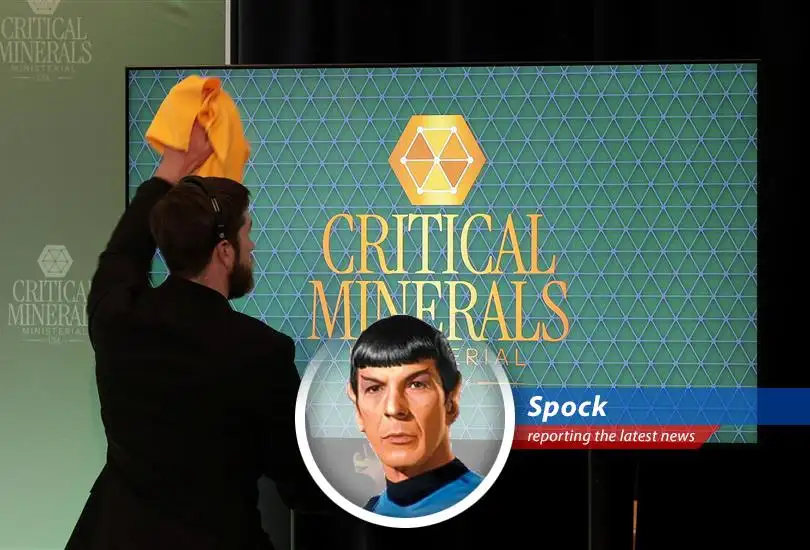
- The U.S. is partnering with Mexico, the EU, and Japan to establish minimum prices for critical minerals.
- This strategy aims to counteract market distortions and secure North American supply chains against disruptions.
- The initiative includes coordinated stockpiling, shared regulations, and investment in geological mapping.
- The U.S. seeks to reduce dependence on China by fostering strategic partnerships and investing in domestic critical mineral companies.
A Logical First Step Securing Critical Minerals
As a Vulcan and a science officer, I find the recent developments in the United States' trade policy regarding critical minerals to be, if not entirely fascinating, certainly noteworthy. The initiative to collaborate with Mexico, the European Union, and Japan to establish minimum price floors for these essential resources represents a logical, albeit belated, step toward securing supply chains. One might even say it's a 'most illogical' situation to allow such vulnerabilities to persist, as they clearly undermine economic stability. This action demonstrates a tangible effort to address what is, to many, an invisible threat to global stability. As Spock once said, 'Without followers, evil cannot spread'. In this context, without secure supply chains, economic stability cannot be guaranteed.
The USMCA and Mineral Vulnerabilities Addressed
The proposed partnership with Mexico under the United States-Mexico-Canada trade agreement (USMCA) is particularly interesting. According to reports, the goal is to address "global market distortions that have left North American critical minerals supply chains vulnerable to disruptions." It is a logical assertion that artificially deflated prices can create instability and over-reliance on single sources, a point highlighted by the Trade Representative Jamieson Greer. The proposal to implement price floors is part of an "action plan" with Mexico that will be implemented in the coming 60 days. It is further suggested that this will be followed by discussions on how to implement minimum prices in agreements with other nations. The US and the EU plan a memorandum of understanding on critical mineral supply chain security in the next 30 days. Some investors are showing concern and the shares of critical mineral companies MP Materials and USA Rare Earth fell more than 6% and more than 9% respectively, but there is also positive signs. The long-term security that this effort will foster will be an enormous boost to the economy and investors will soon realize it. In this context it is very important to ensure that the correct signals are sent to the market that this is a value creating exercise. For investors interested in related sectors, it's crucial to stay informed, particularly considering that [CONTENT] Roblox Rockets Past Expectations Investors Rejoice provides valuable insights into how market dynamics can shift unexpectedly.
Economic Implications A Calculated Risk
The immediate market reaction, with shares of companies like MP Materials and USA Rare Earth experiencing a decline, is not entirely unexpected. As Mr. Spock would point out, "Change is the essential process of all existence." Markets, by their very nature, are resistant to sudden shifts in established paradigms. However, it is the long-term implications that warrant closer scrutiny. The intention to implement coordinated stockpiling of critical minerals, establish common regulations for mining and trade, and coordinate investment in geological mapping presents a compelling case for long-term stability. This proactive approach aims to mitigate potential disruptions and foster a more resilient supply chain. It also aims to ensure a fair distribution of profits to domestic miners and producers, thereby incentivizing further production and innovation. The question of whether this constitutes a calculated risk remains. However, from a logical standpoint, the potential benefits appear to outweigh the immediate market turbulence.
US Dependence on China Reduced Strategically
A key driver behind this policy shift is the United States' strategic imperative to reduce its dependence on China, which currently dominates the global supply chain for these minerals. As the reports suggest, Beijing's past attempts to restrict exports of rare earths during trade disputes underscores the necessity for diversification and self-sufficiency. The actions of the Trump administration in launching a national critical mineral stockpile and taking equity stakes in critical mineral companies further reinforces this commitment. The deal between the Pentagon and MP Materials, which includes a price floor and offtake agreement, is a prime example of proactive intervention to secure domestic supply. In essence, the administration is attempting to apply the principle of 'infinite diversity in infinite combinations' to the realm of mineral resources, diversifying its sources and securing its future.
EU and Japan Join the Alliance
The strategic partnership with the European Union and Japan adds a layer of geopolitical significance to this endeavor. The three entities are committed to developing a new paradigm for preferential trade in critical minerals. This cooperation signals a united front among the world's largest market-oriented economies, demonstrating a collective commitment to addressing vulnerabilities in the supply chain. Discussions on sharing information on stockpiling and cooperating on mining, refining, and processing further enhance the strategic value of this alliance. This collaboration serves as a counterbalance to the current dominance of specific nations in this sector. As Spock might say, 'Logic is the beginning of wisdom... not the end.'
Final Assessment A Promising Trajectory
In summation, the United States' efforts to establish minimum price floors for critical minerals, in conjunction with its partnerships with Mexico, the European Union, and Japan, represents a calculated yet promising trajectory. While immediate market reactions may present short-term challenges, the long-term benefits of securing supply chains, reducing dependence on single sources, and fostering international cooperation are undeniable. As with any complex endeavor, challenges will undoubtedly arise. However, if approached with logical foresight and unwavering commitment, this initiative has the potential to reshape the global landscape of critical mineral resources. Therefore, I would suggest the continued observation of this situation as it unfolds. As Mr. Spock might say, 'Live long and prosper' – especially those with vested interests in securing a stable supply of critical minerals.
critical minerals trade USMCA Mexico European Union Japan price floors supply chain rare earths China
Comments
From Spock





Breaking News






All Rights Reserved © 2023
Ejackk
I'm worried about the impact on developing countries.