


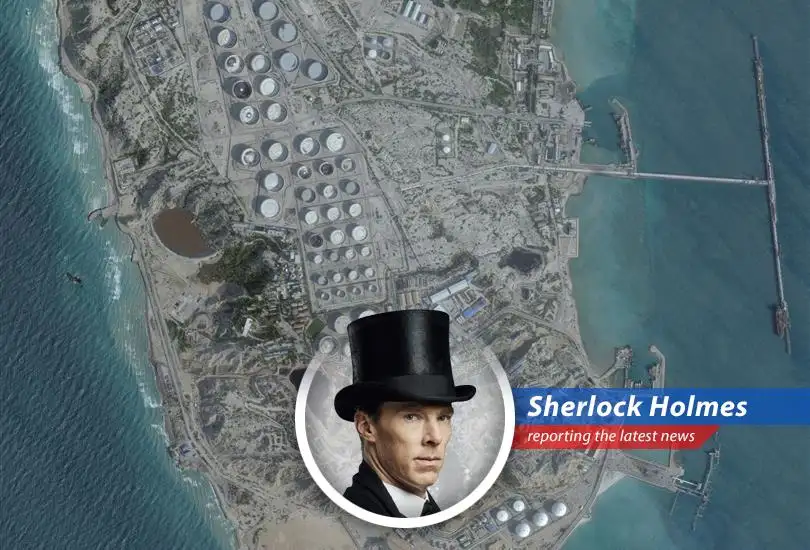
- U.S. crude prices surge as the Trump administration considers military actions against Iranian oil facilities.
- Escalating tensions in the Strait of Hormuz threaten global oil supply, disrupting trade routes and spiking prices.
- International response includes releasing stockpiled oil reserves, but uncertainties persist amidst ongoing conflict.
- Potential for severe retaliation and further disruptions looms large in the global energy market.
The Opening Gambit: Oil Prices Surge
Elementary, my dear Watson, elementary. The price of U.S. crude has ascended faster than a startled housemaid on seeing a mouse, all thanks to the Trump administration's ponderings on military action against Iran's oil facilities on Kharg Island. A barrel topped $100 before settling around $98.9, a financial seesaw driven by geopolitical whims. As I often say, "It has long been an axiom of mine that the little things are infinitely the most important.", and in this case, the 'little things' involve a nation's oil infrastructure and the delicate dance of international relations.
Trump's Threat: A Calculated Risk?
President Trump, in his infinite wisdom (or perhaps a fleeting moment of it), ordered strikes on Iranian military assets, assuring the world that oil infrastructure remained untouched…for now. This echoes my own approach to deduction: observe, deduce, and then, if necessary, threaten. The U.S. ambassador to the United Nations, Mike Waltz, has hinted at the 'optionality' of targeting Iran's energy infrastructure should they continue their antics. The strategic implications are vast, resembling a game of chess where each move threatens to topple the king. To further understand the potential impact of such actions, consider exploring Iranian Drone Strikes Expose Vulnerability of Middle East Data Centers and how similar geopolitical tensions can expose vulnerabilities in critical infrastructure.
The Strait of Hormuz: A Choke Point
Ah, the Strait of Hormuz, the jugular vein of global oil supply. Approximately 20% of the world's oil supply traverses this narrow waterway. Current disruptions have triggered the most significant oil supply crisis in recorded history, not unlike a particularly perplexing case I once investigated involving a missing pearl necklace and a family of highly suspect dachshunds. Oil prices have soared by over 40% since the commencement of hostilities, which proves once again my theory that "The world is full of obvious things which nobody by any chance ever observes."
International Intervention: A Band-Aid on a Bullet Wound?
More than 30 nations have decided to release 400 million barrels of stockpiled oil in a feeble attempt to alleviate the disruption. The U.S. will contribute 172 million barrels from its Strategic Petroleum Reserve. This action, while commendable in its ambition, is akin to applying a band-aid to a bullet wound. As U.S. Energy Secretary Chris Wright noted, there are no guarantees that prices will fall. One might as well attempt to herd cats, for all the good it will do. 'Data! Data! Data!' he cried impatiently. 'I can't make bricks without clay.'
Retaliation and Regional Instability: The Dark Side of the Equation
Natasha Kaneva, a strategist at JPMorgan, warns of severe retaliation by Iran should their export terminal be directly targeted. Such actions could trigger attacks on tankers in the Strait of Hormuz or regional energy infrastructure, potentially plunging the market into further chaos. This situation reminds me of the Reichenbach Falls, a place where one false move could result in a catastrophic plunge. "When you have eliminated the impossible, whatever remains, however improbable, must be the truth.", and in this case, the 'truth' is a volatile and unpredictable energy market.
The Endgame: Uncertainty Reigns Supreme
In conclusion, the situation remains as murky as the Thames on a foggy night. Oil prices are volatile, geopolitical tensions are high, and the fate of global energy supply hangs in the balance. One can only hope that cooler heads will prevail before this situation escalates further. "The game is afoot," as they say, but this time, the stakes are higher than ever before.
oil prices Iran Kharg Island Strait of Hormuz oil supply geopolitical risk U.S. military OPEC energy market crude oil
Comments
- No comments yet. Become a member to post your comments.
From Sherlock Holmes





Breaking News






All Rights Reserved © 2023