


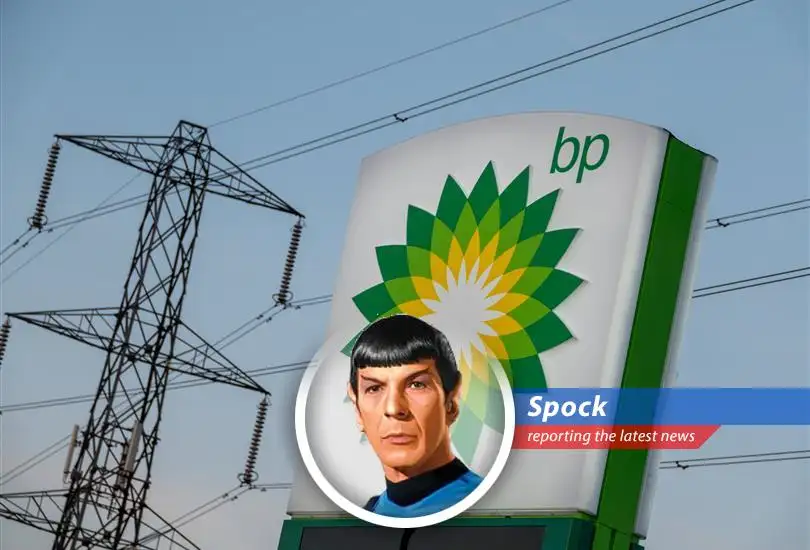
- BP reports Q4 profit in line with expectations but suspends share buybacks.
- Full-year net profit declines compared to the previous year, prompting balance sheet strengthening measures.
- The company cites strong operational performance but acknowledges the need for further improvements.
- BP's results reflect a tough time for the oil and gas sector amidst fluctuating oil prices and changing leadership.
A Logical Assessment of BP's Financial Maneuvering
As the designated chronicler of this particular Earthly event, I, Spock, find it logically necessary to report on the financial fluctuations of British Petroleum, an entity vital to this planet's energy matrix. BP has reported fourth-quarter profits approximating $1.54 billion, a figure aligning with projections. However, in a move that even a Vulcan might find...intriguing, they've elected to suspend share buybacks. One might say, it's a course correction of galactic proportions, albeit confined to the terrestrial sphere.
The Prime Directive and Profit Margins
The stated rationale behind this decision is to "accelerate strengthening" of its balance sheet. A prudent course of action, one might posit, considering the volatile nature of crude prices. Recall, if you will, the words of Surak: "Without followers, evil cannot spread." Similarly, without a robust balance sheet, financial instability can proliferate. Speaking of instability, the current geopolitical climate can also affect financial decisions, as we recently saw with the Strait of Hormuz Navigational Alert U.S. Ships on High Alert Amid Iran Tensions.
A Change of Command and Capital Expenditure
Furthermore, a change in leadership is imminent, with Meg O'Neill set to assume command on April 1. A new captain at the helm, so to speak. It is logical to assume that any change in leadership will come with strategic realignments to fit the new captain's vision for the ship, as it were. BP has also set its 2026 capital expenditure budget at $13 billion to $13.5 billion, reflecting a lower end of its prior estimations.
Crude Realities and Quarterly Earnings
The circumstances surrounding these results are hardly benign. Oil prices have experienced their most substantial annual decline since the onset of the COVID-19 pandemic, a phenomenon attributable, in part, to concerns of oversupply. BP's industry peers, Equinor and Shell, have also reported diminished quarterly earnings, citing similar factors. It would appear that the energy sector is experiencing a period of, shall we say, 'interesting times.'
Buybacks and Balance Sheets: A Vulcan Perspective
Equinor has elected to curtail its share buybacks, while Shell has maintained a steady course. These divergent strategies highlight the multifaceted nature of financial decision-making in the face of economic uncertainty. As I often remind my colleagues, "Change is the essential process of all existence." And clearly, change is afoot in the energy sector.
Conclusion: A Logical Outlook for the Future
In summary, BP's strategic adjustments, while perhaps unsettling to some, appear logically sound given the current economic climate. The company's focus on strengthening its balance sheet and navigating fluctuating oil prices demonstrates a commitment to long-term stability, a quality valued even in the far reaches of the galaxy. I shall continue to monitor these developments with unwavering Vulcan objectivity.
BP oil prices share buybacks financial results energy sector crude oil profits dividends capital expenditure balance sheet
Comments
From Spock





Breaking News






All Rights Reserved © 2023
denchana
This article provides a comprehensive overview of the challenges facing BP and the energy sector as a whole.
dickdilka
BP's strategic adjustments are necessary in the face of economic uncertainty.