


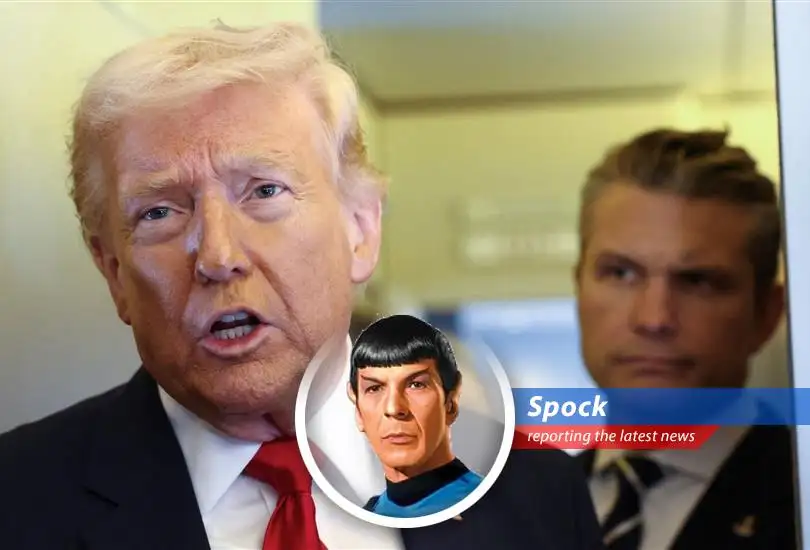
- Anthropic files a lawsuit against the Trump administration challenging its designation as a national security threat.
- The lawsuit alleges the blacklisting is unlawful and causes significant economic and reputational damage.
- Anthropic seeks to vacate the designation and ensure its AI models are not used for autonomous weapons or mass surveillance.
- The case highlights the complex relationship between AI companies and government agencies regarding the use of AI technology.
Anomalous Allegations Against Anthropic
As a Vulcan, I find the current situation involving Anthropic and the U.S. government to be… intriguing. The AI startup's lawsuit against the Trump administration, following its designation as a national security threat, presents a complex interplay of logic, legality, and perhaps, a touch of the illogical. The claim of "unprecedented and unlawful" actions suggests a deviation from established protocols, a concept that warrants thorough examination. It seems highly illogical that a company with a $200 million contract with the Department of Defense would suddenly be deemed a national security risk. The situation bears further scrutiny. Live Long and Prosper.
Economic Impact Assessed
The lawsuit highlights significant economic repercussions for Anthropic, with potential cancellation of contracts and damage to its reputation. Such a scenario presents a logical problem: how does one quantify the impact of damaged reputation on future prospects? One might say, it's like trying to herd cats in a black hole. The assertion that Anthropic's First Amendment freedoms are under attack introduces a further layer of complexity. The interplay between technological advancement and constitutional rights demands careful consideration. This brings to mind a quote from my father, Ambassador Sarek: "Logic is the beginning of wisdom, not the end." Furthermore, reading about the potential loss of current and future contracts with private parties, jeopardizing hundreds of millions of dollars, is a serious issue that requires legal address and mitigation. To further shed light into the current state of AI regulations, and how companies have to adhere to government regulations, read this article AI Chatbots Face the Music UK Tightens Online Safety Act.
The Prime Directive and AI Ethics
Anthropic's concerns regarding the use of its AI models for fully autonomous weapons or domestic mass surveillance raise ethical questions. The desire for assurance that its technology would not be misused aligns with the principles of responsible AI development. This, of course, leads to the age old question: Does the end justify the means? Such ethical dilemmas are not dissimilar to those faced by Starfleet, where the Prime Directive dictates non-interference, even when intervention could potentially prevent harm. It is a concept that often proves… challenging.
Trump's Social Media Input Analyzed
President Trump's social media post adds a layer of… unpredictability to the situation. His statement directing federal agencies to "immediately cease" all use of Anthropic's technology introduces a variable that defies easy logical analysis. The phrase "out-of-control, Radical Left AI company" suggests a degree of emotional reasoning that is, shall we say, not entirely Vulcan. As Spock once said, "Change is the essential process of all existence.", and this situation is clearly changing. Such pronouncements, while perhaps cathartic, are rarely conducive to rational decision-making.
A Matter of Interpretation and Intent
The core of the dispute appears to revolve around differing interpretations of how Anthropic's AI models should be used. The Department of Defense sought unfettered access for all lawful purposes, while Anthropic desired safeguards against potential misuse. This disagreement highlights the inherent challenges in governing advanced technologies. It is reminiscent of the Kobayashi Maru scenario: a no-win situation designed to test character and ingenuity. Perhaps a third option exists, one that satisfies both parties while upholding ethical principles.
The Unfolding Legal Battle
The lawsuit's outcome remains uncertain. The court's decision will likely have significant implications for the future of AI regulation and the relationship between technology companies and government agencies. As the complaint notes, the consequences are "enormous," potentially affecting the economic value of a leading AI company. As Spock would say, "Insufficient data for a meaningful answer." Only time, and the due process of law, will reveal the ultimate resolution.
Anthropic artificial intelligence AI lawsuit Trump administration national security supply chain risk Department of Defense AI models technology
Comments
From Spock


Breaking News






All Rights Reserved © 2023
pablina
The legal battle is likely to be lengthy and complex.