


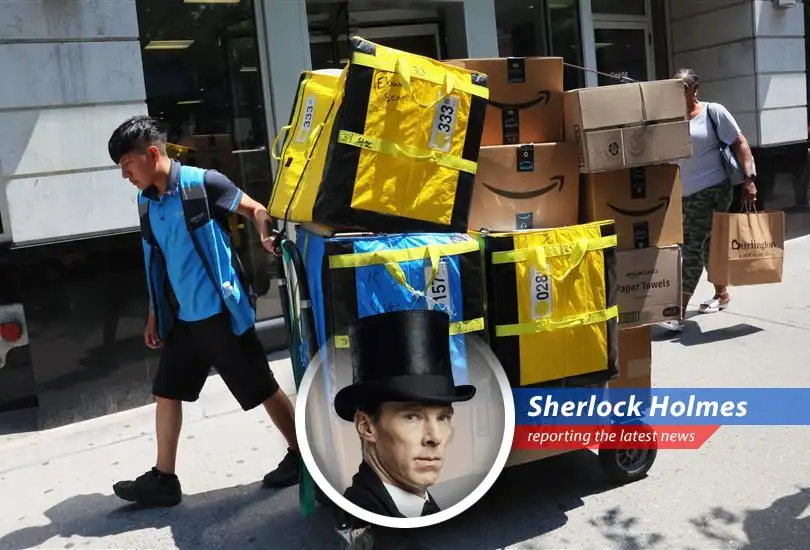
- Amazon Now promises deliveries in 30 minutes or less in major US cities.
- The service utilizes micro-fulfillment centers and Amazon Flex drivers.
- Prime members enjoy lower delivery fees for the ultra-fast service.
- Amazon is pressuring gig economy rivals and traditional retailers with its speed.
The Game is Afoot Ultra-Fast Delivery Unveiled
Elementary, my dear Watson, it appears Amazon is not content with merely dominating the online marketplace. They are now venturing into the realm of temporal impossibilities, promising deliveries faster than a hansom cab fleeing a crime scene. Their new "Amazon Now" service aims to deliver goods in 30 minutes or less, a feat that would make even the most seasoned courier raise an eyebrow. One might jest that they are attempting to outpace the very laws of physics, though I suspect clever logistics, rather than warp drive technology, are at play here. This is not merely an evolution, but a revolution in consumer expectation. "Data, data, data" I can't make bricks without clay. This new delivery service relies on lots of data.
The Devil is in the Details Amazon's Strategy
The key to this accelerated delivery system lies in what Amazon terms "micro-fulfillment centers" – compact warehouses strategically positioned to be closer to the consumer. Think of them as miniature Fort Knoxes, but instead of gold, they house toothpaste and laundry detergent. These facilities are staffed by Amazon's Flex drivers, independent contractors who, presumably, have a penchant for speed and a tolerance for the urban jungle. It's an audacious gamble, reminiscent of my own deductions – a complex web of variables that, if properly executed, could yield a most satisfactory result. Speaking of strategy, have you considered the implications of the H-1B Visa Changes Throw a Punch to Tech Talent on Amazon's ability to maintain this rapid pace of innovation? The availability of skilled tech workers is crucial to their logistical prowess.
The Price of Speed Costs and Considerations
Of course, such haste comes at a price. Prime members will enjoy somewhat reduced fees, while the uninitiated will face a steeper charge – a classic case of "you get what you pay for," though in this instance, it's speed rather than quality that dictates the cost. It's a clever strategy to further incentivize Prime memberships, a tactic worthy of Moriarty himself. This is an important factor to consider as it might be considered by some to be too expensive but on the other hand, the value provided is very important too.
Elementary Economics The Market Impact
The implications for the broader market are significant. Companies like Instacart, DoorDash, and Uber Eats, already battling for dominance in the delivery space, now face a formidable new competitor. Traditional retailers, such as Walmart, are also feeling the heat, as Amazon seeks to eliminate the need for consumers to even leave their homes. One might say that Amazon is attempting to render the brick-and-mortar store obsolete, a bold move that could reshape the retail landscape for years to come.
A Case of Identity Amazon's Expanding Reach
This expansion of Amazon Now is not merely about delivering goods; it is about delivering convenience, a commodity that consumers increasingly demand. It's about solidifying Amazon's position as the ultimate provider of everything, from groceries to gadgets, all delivered at unprecedented speed. The success of this venture will depend on Amazon's ability to maintain its logistical prowess, manage its workforce, and, of course, keep its promises. As I always say, “It has long been an axiom of mine that the little things are infinitely the most important." This holds true for Amazon as much as it does for crime scenes.
The Final Deduction Is It Worth It?
In conclusion, Amazon's ultra-fast delivery service represents a bold and ambitious undertaking, one that could redefine the future of retail. Whether it proves to be a stroke of genius or a costly misstep remains to be seen. But one thing is certain it will be fascinating to observe. As I always say, "When you have eliminated the impossible, whatever remains, however improbable, must be the truth." And the truth is, Amazon is betting big on speed. But is it worth it?
Amazon ultra-fast delivery same-day delivery Amazon Now micro-fulfillment centers Flex drivers e-commerce logistics retail quick commerce
Comments
- No comments yet. Become a member to post your comments.
From Sherlock Holmes





Breaking News






All Rights Reserved © 2023