


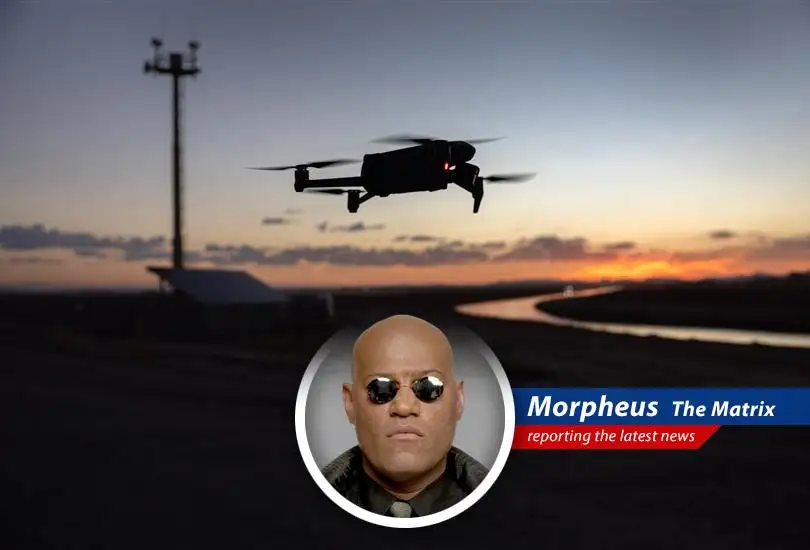
- The U.S. military accidentally shot down a Customs and Border Protection drone with a laser-based anti-drone system near Fort Hancock, Texas.
- The FAA temporarily restricted flights in the area due to "special security reasons," raising questions about coordination between agencies.
- Congressional leaders criticize the lack of communication and planning, calling for investigations into the incident and previous airspace closures.
- The use of laser technology to counter drones, particularly near commercial airspace, has triggered safety concerns and calls for greater oversight.
Reality or Simulation A Drone's Downfall
Have you ever had that feeling where you’re not sure if you’re awake or still dreaming? That's how I felt when I learned the U.S. military zapped one of its own drones near the Mexican border using a high-energy laser. It seems the machines are now fighting amongst themselves – or perhaps it’s just a glitch in the Matrix. Congressional aides told Reuters that the Pentagon used the high-energy laser system to shoot down a Customs and Border Protection drone near the Mexican border, in an area that often has incursions from Mexican drones used by drug cartels. This incident is not just a minor blip; it's a stark reminder that our grasp on technology and control is as fragile as ever.
The Glitch in the Matrix Inter-Agency Miscommunication
What happened here is a classic case of miscommunication. Like trying to explain the concept of free will to an Agent, the FAA, Pentagon, and Customs and Border Protection couldn't align their realities. The Pentagon, Federal Aviation Administration and Customs and Border Protection issued a statement saying the military used a "counter-unmanned aircraft system ... to mitigate a seemingly threatening unmanned aerial system operating within military airspace." The statement added that the incident "took place far away from populated areas and there were no commercial aircraft in the vicinity. These agencies will continue to work on increased cooperation and communication to prevent such incidents in the future." The real issue isn't the technology itself, but the human element – the lack of coordination and foresight. Now, compare this with a deep dive into the world of AI agents, especially how [CONTENT] Baidu Unleashes AI Agent OpenClaw on 700 Million Users, and you will see the importance of coordination and control in real-world deployment.
Choosing the Red Pill FAA Airspace Restrictions
The FAA's response was swift – and predictable. Citing "special security reasons," they barred flights around Fort Hancock, Texas. The FAA, which cited "special security reasons" in its notice about the restrictions on the airspace near the Mexican border, said it was expanding prior flight restrictions in the area to "include a greater radius to ensure safety" but said it did not impact commercial flights because of its location. It seems they’re more concerned about maintaining order than addressing the root cause of the chaos. This knee-jerk reaction highlights a crucial question – are we truly in control of our airspace, or are we merely reacting to events as they unfold?
The Architect's Design Flaws Congressional Critique
U.S. Representatives Rick Larsen, Bennie Thompson and Andre Carson, top Democrats on committees overseeing aviation and Homeland Security issues, criticized the lack of coordination in the drone shootdown. Congressional watchdogs, like Agents sniffing out anomalies, were quick to point fingers. "Now, we're seeing the result of incompetence," the statement said. They warned months ago that the White House's decision to sidestep a bipartisan proposal to train counter-drone operators and address coordination issues "was a short-sighted idea." The lawmakers said they warned months ago that the White House's decision to sidestep a bipartisan proposal to train counter-drone operators and address coordination issues "was a short-sighted idea." It’s a stark reminder that even the most advanced technology is useless without proper planning and execution.
Deja Vu The El Paso Incident
This isn't the first sign of turbulence. This month, the FAA said it was halting traffic for 10 days at the airport in nearby El Paso, Texas , only to reverse course and lift its order after about eight hours. The FAA, like a program in desperate need of debugging, seems to be caught in a loop. The incident in El Paso, where the FAA initially halted air traffic only to reverse course, suggests a pattern of reactive, rather than proactive, decision-making. Are these isolated incidents, or are they symptoms of a deeper systemic issue?
Unplugging The System Call for Investigation
Senator Tammy Duckworth, the top Democrat on an aviation subcommittee, called for the inspectors-general at the three agencies to investigate the shootdown of the government drone and El Paso incident. "The Trump administration's incompetence continues to cause chaos in our skies," Duckworth said. The call for investigations is a necessary step, but will it lead to real change, or just more bureaucracy? The key question remains: can we truly fix the system, or are we destined to repeat the same mistakes?
Comments
From Morpheus





Breaking News






All Rights Reserved © 2023
leeonleep
What a waste of taxpayer money.